The Pilates Method
Joseph Pilates, body and mind coordination, and the Reformer.
 Key dates: 1914-18 · 1926 New York · the 1930s · 1967 · the 1950s in France
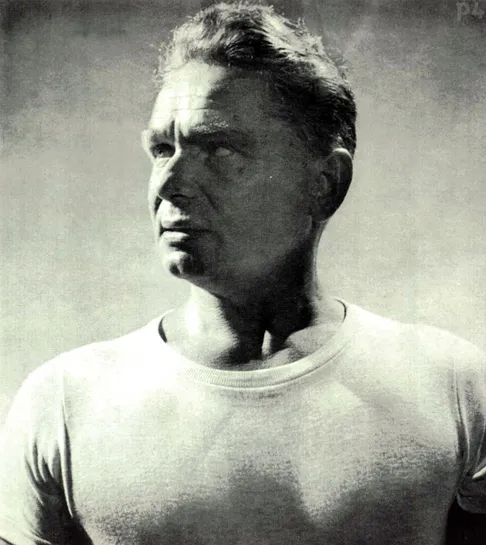
Joseph Pilates
"During the 1914-1918 war, Joseph Pilates — who was German by origin — was taken prisoner in England and assigned as a nurse in a camp for wounded soldiers. In the course of his work with the war wounded, he devised a whole series of physical exercises using the patients' beds, to help them recover their mobility and above all their musculature. It was from a system of rings and springs attached to the bed frames, creating resistance, that he contributed to their rehabilitation. This is the origin of the "Universal Reformer" (a horizontal machine). It was observed that the wounded men in his care recovered faster than the others."
After the war, Joseph Pilates returned to Hamburg in Germany, where he defined his method and his equipment more precisely.
In 1926, Pilates left Germany for the United States. On arriving in New York, he opened his own studio and attracted the interest of the dance world, which embraced his method and carried it forward over the long term.
During the 1930s, he worked closely with dancers such as Ruth Saint Denis and Ted Shawn, Martha Graham (whose dancers all practised the method), George Balanchine, Hanya Holm and Jérôme Andrews. Pilates preferred working with dancers because they had an intuition for movement.
When Joseph Pilates died in 1967, many of his students and assistants opened their own studios. This had the effect of opening his work to a wider public than athletes and the American dance world alone.
Pilates left no particular instructions regarding his method, how it should be practised or taught. Its transmission remains above all oral, grounded in practical knowledge, which matters more than theoretical knowledge.
It was through Jérôme Andrews (1908-1992) that the Pilates Method and its apparatus arrived in France in the 1950s. An American dancer, he is considered one of the most brilliant of his generation. Having become Joseph Pilates' assistant, he developed work with dancers at the New York studio. Declining the offer to take over the studio, he chose to settle in France to develop his own dance company. It was then that he introduced the Universal Reformer. On arriving, his aim was not to make Joseph Pilates' work known: he devoted himself to developing his own choreographic language. He introduced his first dancers to the machine, among them Jacqueline Robinson, Solange Mignoton and later Françoise and Dominique Dupuy (an emblematic figure of this work), who carry on Jérôme Andrews' legacy in France.
"The only way to achieve true fitness is progressive and intense physical work connected to a symbolisation of body and mind."
After Joseph PilatesHe built his method on the principle of complete coordination of the mind, the body and the spirit. This holistic perspective, based on mental concentration, a specific way of breathing and the more physical aspect of gymnastics, gives his technique its originality and its depth.
I believe that work on the body can only be conceived within an overall relationship to the person. The classes offered at the Pilates studio — Le Corps Parlant seek to maintain that fine thread of the relationship to oneself, as the founder intended: respectful and alive.
The Reformer
In France, for a very long time, people did not speak of the "Reformer" or the "Cadillac"… but of "the machine". Devised in the 1920s, this method of exercise and of living appeared in France around 1960, introduced by Jérôme Andrews, Joseph Pilates' assistant, and taken up by French dancers, in particular Françoise and Dominique Dupuy.
Developed at that time first within the contemporary dance world, it is now making its way into every fitness profession, under the influence of English and American schools and training programmes.
Originally, in the prison and hospital conditions of his early days, Pilates worked with the tools and materials he had to hand — a bed, springs, a chair — to invent an original method of physical education. Named contrology in its early days, it consists of precise exercises intended to improve strength and flexibility. It brings the body a natural balance.
- breathing, visualisation, concentration;
- the essential synergy between breathing and muscular work;
- support and endurance;
- the body as a whole, with suppleness and fluidity;
- the extension and release of the musculature as a whole;
- deep work on every part of the body.
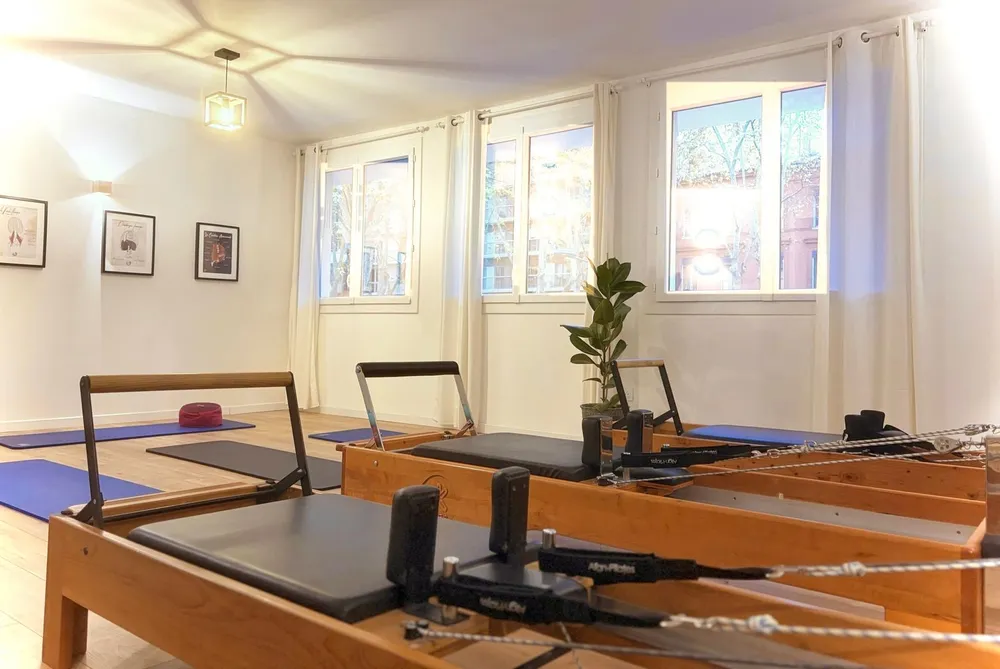
Improved and "civilised", these tools remain based on the same principle. The most universal of them is called the "Reformer".
This apparatus allows work that mobilises the whole body continuously, rather than one part of it. It is not the instrument that leads the work: through the graduated resistance it produces, it allows the body to structure itself and to progress, combining breathing, movement and the "symbolisation" of movement. Pilates maintained consistently that a visualised movement becomes far more effective. From this point of view, what matters is the accuracy of the movement — quality rather than repetition.
What makes Pilates machines distinctive is that they are fitted with springs rather than weights: the body works against resistance rather than against load, which reduces the risk of injury to both muscles and joints. Most exercises are performed lying down or seated, avoiding excessive strain that could endanger the spine or the joints.
Beyond its technical aspect as a tool, the machine also acts as a mediation. A mediation between the person demonstrating and the person doing, but also a mediation in relation to oneself, to the often mistaken image we hold of ourselves and of what we are capable of. It allows you to rediscover new sensations, to feel areas or parts of the body, to name them, and gradually to begin working with your body rather than against it.